
Noah's Ark
A Story & Table Newsletter

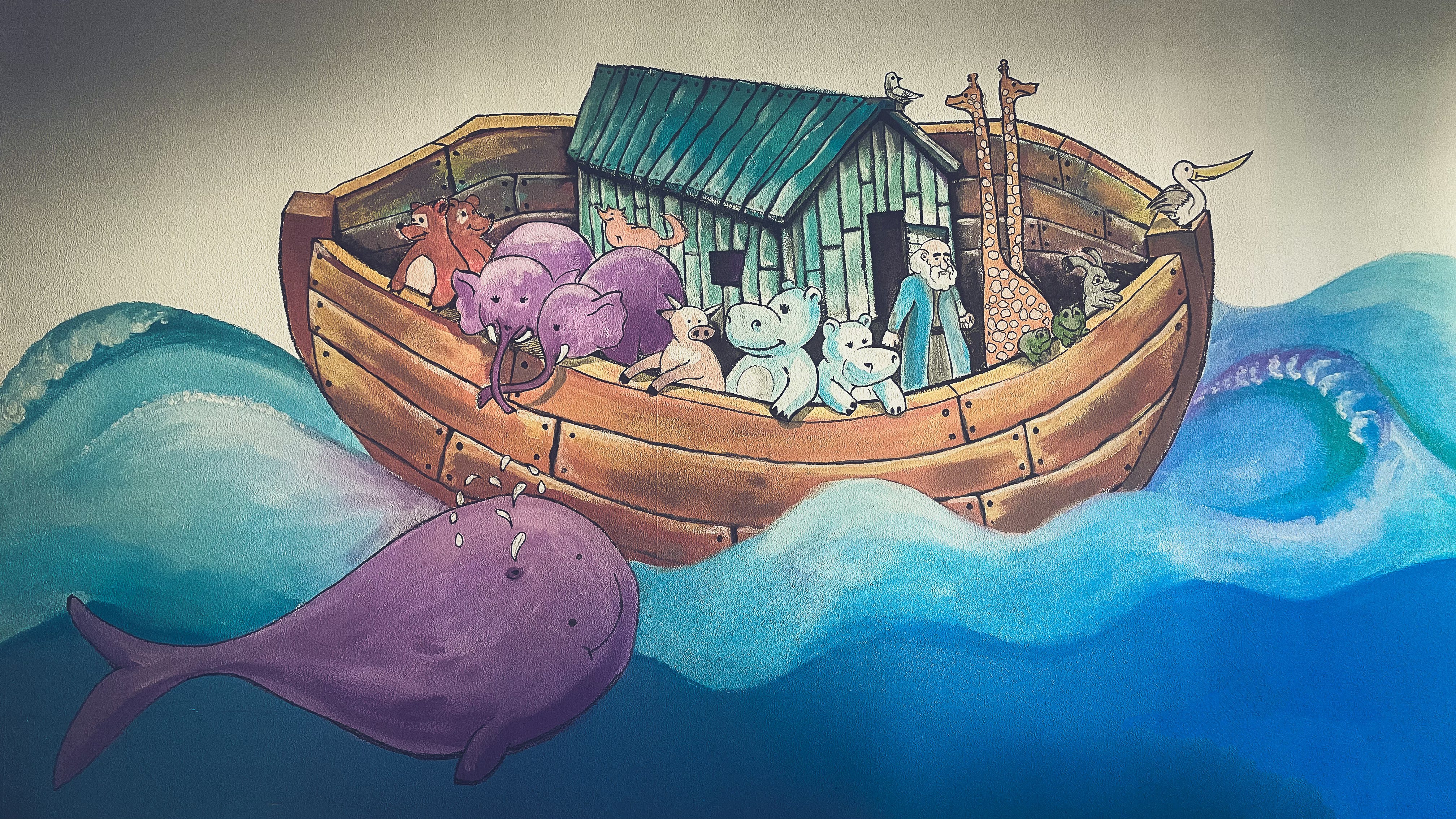
Let’s keep demanding better storytelling. In that spirit, Noah’s Ark…
The Story We Have Been Told
A long, long time ago, humans did wicked things that made God sad and really, really mad.
So sad, God regretted creating humans.
So mad, God decided to flood the entire earth.
Fortunately, there was one good human named Noah, who God decided to save by telling him to build an ark.
In perfect obedience, Noah and his family built an ark. They then filled the ark with two kinds of every animal. And then, just as they finished building the ark and loading the animals, the rain began to fall. Over the course of many days and nights, God’s flood killed everyone and everything.
Everyone and everything, except for Noah and his family, and the animals on the ark.
And then, the rain stopped.
And the water went away.
And the ark came to rest on a mountain peak.
Noah then sent out a dove and when it didn’t return he knew it was safe to exit the ark.
Noah made an altar and offered a sacrifice, and God said, “I promise to never flood the earth again.” And God put a rainbow in the sky so that every time humans see a rainbow, they’re reminded that God won’t flood the earth.
The End.
The Table This Story Sets
This storytelling is intended to have a positive effect, although I don’t believe it does in any way whatsoever.
Let’s take an honest look at a few implications.
One feature of the table this story sets is the belief that God can become so disappointed in humans that God may regret creating them.
Imagine a reality in which a child is disobedient and their parent tells them, “I wish you were never born.” Is that good parenting? Of course not. It’s terrible. However, a direct application of the story just told is that this kind of parental disappointment is, literally, godly. That’s a problem.
A second feature of the table this story sets is the belief that God can become so disappointed in humans that God may decide to kill them.
This point is about more than mere punishment for disobedience. It’s about murder. In this storytelling, besides Noah and his family, God murders every single person and animal on earth. This storytelling cannot be mistaken for justice; it’s genocide. Further complicating this storytelling is that it contradicts other stories told about God. For example, Matthew 5, where Jesus says, “[God] causes the sun to rise on the evil and the good, sends rain on the righteous and the unrighteous. For if you love those who love you, what reward to you have? Do not even the tax collectors do the same?”
A third feature of the table this story sets is the centering of the wrong character.
This is an interpretive point and it’s essential. In scripture, sometimes the stories are human (anthropocentric) focused. However, at other times the stories are God (theocentric) focused. Recognizing who is at the center of a story gives meaningful shape to the way a story is interpreted.
Today, storytelling about Noah’s Ark centers Noah. As a result, the primary conclusions emphasize the consequences of human behavior. For example, if we’re good, God will reward us. However, if we’re bad, God will punish us. This is problematic for at least three reasons. First, as previously mentioned, this interpretation contradicts other stories told about God. Second, from a Christian perspective, this interpretation subverts the theological concept of grace by advocating for good behavior to ensure God’s favor. Third, this interpretation totally misses the radical shift in the story, which occurs to its central character—God, not Noah.
The Story We Need To Hear
In this flood story, we get a window into how ancient people attempted to make sense of cataclysmic events.
That’s to say, something bad happened—like an earthquake or a fire or a flood—and ancient people would try to understand how it happened and why it happened.
Of course, ancient people all believed in gods, and so these gods became the focus of how and why bad things occurred.
Now, here is where things begin to get interesting.
The majority of ancient people have some kind of flood story in their storytelling. And chief among all of these flood stories is the very ancient story found in what is called the Gilgamesh Epic.
The Gilgamesh Epic was written between 2100 and 1200 BCE, in ancient Mesopotamia.
Mesopotamia—current day Iraq—is the region that Israel lived within and around, and so they would have been very familiar with this story, which I will now tell.
The heavenly council of the gods, led by Abu and Enlil, decide to destroy humankind because they were multiplying too much and making too much noise. However, this decision wasn’t unanimous. And so, the god Enki tips off the human Utnapishtim. Utnapishtim means “finder of life.” As a result, Utnapishtim builds a boat and fills it with his family and animals.
The rain begins to pour.
After many days the rain stops and the boat eventually comes to rest on the top of a mountain.
Utnapishtim sends out a dove and when it doesn’t come back everyone exits the boat.
Utnapishtim then builds an altar and offers a sacrifice.
The gods smell the sweet savor and crowd around it like flies until Enil arrives and is furious to find out that a human and his family survived the flood.
The gods beg Enil to let it go, which he does.
Enil then enters the boat with Utnapishtim where he blesses him, and Utnapishtim is made to be like a god who lives among the gods.
The End.
These two ancient flood stories have many similarities.
In both stories:
God and the gods are enraged by humans.
God and the god Enil decide to wipe out humankind.
God and some of the gods decide to save humankind.
A boat gets stuck on a mountain peak.
A dove is sent out and when it doesn’t return, the surviving humans exit the boat.
Altars are built and sacrifices are made.
These are the similarities. However, what’s interesting and most helpful for interpreting the story of Noah’s Ark are the differences. And central to the differences is the main character.
In the Gilgamesh epic, it’s all about Utnapishtim whose name, remember, means “finder of life.” In this story, after being warned that a flood is coming, an extended first-person narrative is told by Utnapishtim himself:
I provided the boat with six decks.
I laid out the counters.
I hammered the water plugs.
I made the punting poles.
I laid the supplies.
I killed the sheep every day.
I made my family and kin go aboard the ship.
I watched the appearance of the weather.
I boarded the ship and battened up the entrance.
In other words, I, I, I, Utnapishtim, am the finder of life.
In contrast to this ancient flood story that emphasizes Utnapishtim—the finder of life—is Noah, which can be translated as “quiet” or “rest.” And throughout Israel’s telling of this ancient flood story, the “quiet” Noah does very little in comparison to its main character, God:
God decided to flood the earth.
God commanded Noah to make an ark.
God gave Noah instructions on how to make the ark.
God said to Noah, “I will make a covenant with you and you shall come into the ark.”
God insisted that Noah bring animals into the ark.
God shut Noah and his family in the ark.
God remembered Noah and the animals on the ark.
God made a wind blow to cause the waters to subside.
God said to Noah, “Go out of the ark.”
God said, “I will never again curse the ground because of humankind.”
God said, “I’m establishing my covenant with you.”
God said, “As for me, I am establishing my covenant with you and your descendants after you, and with every living creature that is with you.”
God said, “Never again shall flesh be cut off by the waters.”
God said, “When the [rain]bow is in the clouds, I will see it and remember the everlasting covenant between God and every living creature of all flesh that is on the earth.”
God said, “This is the sign of the covenant that I have established between me and all flesh that is on the earth.”
You see, the Gilgamesh Epic is all about the mighty Utnapishtim—the finder of life—who heroically saves himself along with humanity, and in the process becomes a god among the gods. However, in Noah’s Ark, Noah is mostly quiet, as we bear witness to an enormous shift in God’s own self.
As we bear witness to an enormous shift in God’s own self.
This is a radical idea!
Here’s a brief explanation of the Bible’s trajectory…
As I explain in my article “The Bible—An Inspired Text, Written by Humans,” the scriptures are inspired by God but written by humans.
Written by humans, who—although inspired—existed in particular times and contexts that gave shape to how they understood life and God. With this in mind, consider a few passages from the Bible:
Exodus 20:1-17, provided an ancient moral code.
Numbers 35:6-15, demanded cities of refuge for those who accidentally killed someone to flee to and to dwell within so that the Revenger could not exact revenge.
Deuteronomy 21:10-14, established protocol allowing women who were captured in war to grieve for one month. Furthermore, if after taking a woman to bed the man found himself unhappy with the woman, he was prohibited from selling her and he was instructed to let her go wherever she wished. I know this is horrifying, but please stick with me.
Romans 14-15, differentiated between strong and weak consciences when it came to eating clean and unclean food and it encouraged acceptance of the “other.”
Philemon, Paul wrote to a slave owner named Philemon and asked him to receive back a runaway slave named Onesimus, not as a slave, but as a brother.
Now—as terrible as these passages seem to us today—it can be observed that these were movements forward in an ancient world.
A moral code in the midst of violent tribalism, was a movement forward.
Refuge for the innocent when a Revenger was allowed to exact revenge, was a movement forward.
Allowing space for a woman to grieve and to be set free as opposed to sold, was a movement forward.
Making room for differences when it came to clean and unclean food, was a movement forward.
Receiving back a runaway slave as a brother instead of as a slave, was a movement forward.
Of course, these movements don’t go far enough.
How about just putting an end to the notion and role of a Revenger, or treating women as human beings instead of as property, or making room for differences beyond clean and unclean food, or abolishing slavery altogether?
Yes!
But to do so would have been unconscionable for the biblical writers.
Such consciousness about human rights and dignity were beyond ancient Israel, the early church, and the apostle Paul.
However—in their day and age—this observable trajectory illuminates movements that were radical, good, compassionate, and beautiful steps forward.
Beautiful steps forward.
This is what we witness in the story of Noah’s Ark.
Israel takes a cataclysmic flood story—thought to be the result of God’s anger at humankind—and by its end…
       God is no longer fuming and wrathful,
              but gracious and kind.

      God is no longer fuming and wrathful,
              but in covenantal relationship with
              humans and all of creation.

	God is no longer fuming and wrathful,
              but reminded by a rainbow in the sky
              to no longer fume or behave
                      wrathfully.
In these ways, the story of Noah’s Ark gestures toward a shift, a click, a step forward in ancient Israel’s understanding of God, who—as the story’s main character—evolves.
The Table This Story Sets
The implications of this storytelling stand in stark contrast to those made through the usual storytelling of Noah’s Ark.
One feature of the table this story sets is trust in a gracious God in the midst of cataclysmic events.
What are we to think about a tsunami or an earthquake or a fire, or any other kind of devastating incident? Well, according to this storytelling of Noah’s Ark, it is no longer the result of God’s fury or wrath. Because, according to this storytelling, God now stands in gracious covenant with humankind and all of creation. In fact, based on this storytelling, it would be more accurate to say that when a tsunami or an earthquake or a fire, or any other kind of devastating incident occurs, God’s heart breaks.
A second feature of the table this story sets is human agency to respond to cataclysmic events.
Rather than returning to the consciousness of ancient people who spent lots of time trying to discern what cataclysmic events told them about God, we can spend our time acting. One way we can act is to, along with God, grieve the loss of life. A second way we can act is to metabolize our grief by helping to alleviate the suffering of others and by restoring that which has been destroyed. We can do this by sending money to disaster relief organizations and by volunteering. A third way we can act is by asking, “Did we humans have anything to do with this devastation?” The science is clear that we humans are the primary cause of climate change. And this change is the result of evermore cataclysmic events. This realization can animate us to care more deeply about the impact our personal choices have on the creation. It can also give shape to the climate initiatives we support and the leaders we elect.
A third feature of the table this story sets is the making of creation into sacrament.
A sacrament is a sign of God’s grace. And in the story of Noah’s Ark, the rainbow becomes just that—a sign of God’s grace. Similarly, in the sermon on the mount, Jesus speaks often about God’s love for humankind and all of creation. At times, he even points at creation to speak about God’s tender care:
	Look!

        Look at the birds of the air;
        they neither sow nor reap nor gather
        into barns, and yet your heavenly Father
        feeds them.

        Consider!

        Consider the lilies of the field,
        how they grow;
        they neither toil nor spin,
        yet I tell you, even Solomon
        in all his glory  was not clothed
        like one of these.
In this way, it could be rightly said that all of creation is a sacrament. And so, just as the story of Noah’s Ark invites us to imagine God’s graciousness through the sighting of a rainbow, so all of creation sings of God’s graciousness and we’re invited to sing along.
A fourth feature of the table this story sets is the invitation to evolve along with our stories about God.
In the story of Noah’s Ark, God’s methodology for dealing with humans who do bad things evolves. In the beginning, God is angered by human wickedness, which results in genocide. At the end, God is compassionately transformed and makes a covenant to never again curse the ground or to destroy every living creature because of human wickedness.
For far too long we humans have dealt with our judgments of wickedness through anger that animates violence. Similar to God at the beginning of this story, in the heat of our anger, violence feels just. But, as this radical story explains, it isn’t. Violence is violence, and it does little to make for good. If anything, human history makes clear that violence just begets more violence. And yet, many humans still think that bombing, shooting, and killing are the way to peace. Most tragically and quite ironically, it is today’s Christians who—in the name of a crucified Jesus—approve of this methodology. Will we ever evolve, like God?
Oh God, I hope so.
Thanks Mike ... interesting to think about the progression: is it because God has to evolve, or is it that "we can't handle the truth" of something too far beyond our own personal Overton windows? I know I often want the "perfect" - but to get to the cool Phd level research, I might actually have to take the string of prerequisites: ends up getting from A to C may actually require going through B.
Sadly the path isn't always linear, and we're certainly seeing that today. This progression, though, may be instructive on where we go next. If we push societal answers that "we" aren't ready for yet, we may need to take the baby steps now to enable bigger steps later. That requires patience I don't want to have.